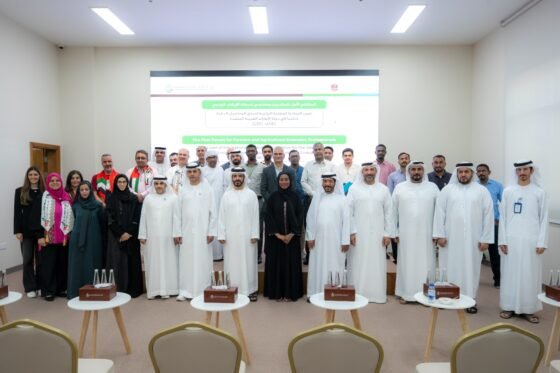
One hundred and thirty-one people attended the Clean Energy Business Council’s 14th annual summit at the DIFC Conference Centre. Farnek, the event’s carbon neutrality partner, put its footprint at 7.46 tonnes of carbon dioxide equivalent. Divide that by attendance and the result is about 57 kilograms per delegate. That is a share of the whole event, including the venue and its suppliers. An individual delegate’s journey could account for considerably more or less.
What went into the count? Farnek says it included travel and accommodation alongside energy, catering, materials, logistics and waste. This matters when comparing two events. A conference that counts delegates’ flights is answering a different question from one that measures only what happens inside the venue. Farnek’s published summary gives the total across those categories. A breakdown would show organisers where a change could have the biggest effect.
What did the organisers change? Farnek reports that the summit avoided single-use plastics and offered more sustainable catering choices. Its summary gives no estimate of the emissions saved by either measure. The 57-kilogram figure is a starting point for the next edition. Reporting both the total and the per-person average again, with the same activities included, would allow readers to see whether overall emissions fell even if attendance changed.
Where do the eight credits fit? Farnek reports retiring eight Gold Standard credits, representing eight tonnes of carbon dioxide equivalent, against the 7.46 tonnes it calculated. Retirement takes credits out of circulation so they cannot be used for another claim. The event’s measured footprint remains 7.46 tonnes. Keeping that number visible alongside the offsets gives the next organising team a concrete target to improve on. Farnek’s published account of the summit.
Pictured: a panel at the Clean Energy Business Council summit. Photograph supplied by Farnek.