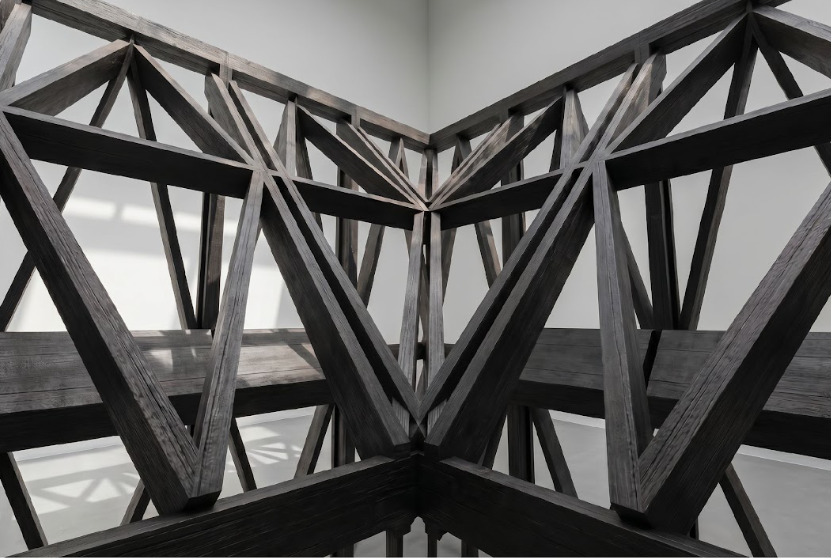
A weaver can pass a pattern to another pair of hands through a set of coded instructions. For Taleem, Kashmiri architects Owais Asif Khan and Samreen Junaid Wani applied that idea to a different material. Their Dubai-based practice, VARUSSI, designed an installation from reclaimed construction timber for the Abwab programme at Dubai Design Week, held from 3 to 8 November.
From loom to building site
The architects drew on the notation used in Kashmiri hand-knotted carpet and Kani shawl-making. On a loom, a sequence of instructions lets a maker build up a pattern through repetition. VARUSSI carried the principle of repetition into the installation, giving visitors a way to encounter an idea usually exchanged between craftspeople.
The choice of timber gave the project a second, practical question. What happens to a temporary structure once an exhibition closes? According to Emirati interiors company Faham, which supported the installation, the team sourced, fabricated and assembled the modules in the UAE. They designed them to come apart and fit together again. A future installation could reuse the work already invested in shaping each piece. Its next destination has yet to be announced in the supplied project material.
Taleem was conceived for In Other Words, an Abwab exhibition bringing five creative practices together at Dubai Design District. Among its explorations of how knowledge travels between generations, VARUSSI offered a particularly tangible example. Both a weaving pattern and a set of reusable building parts can outlive a single making.
Design image courtesy of Faham.